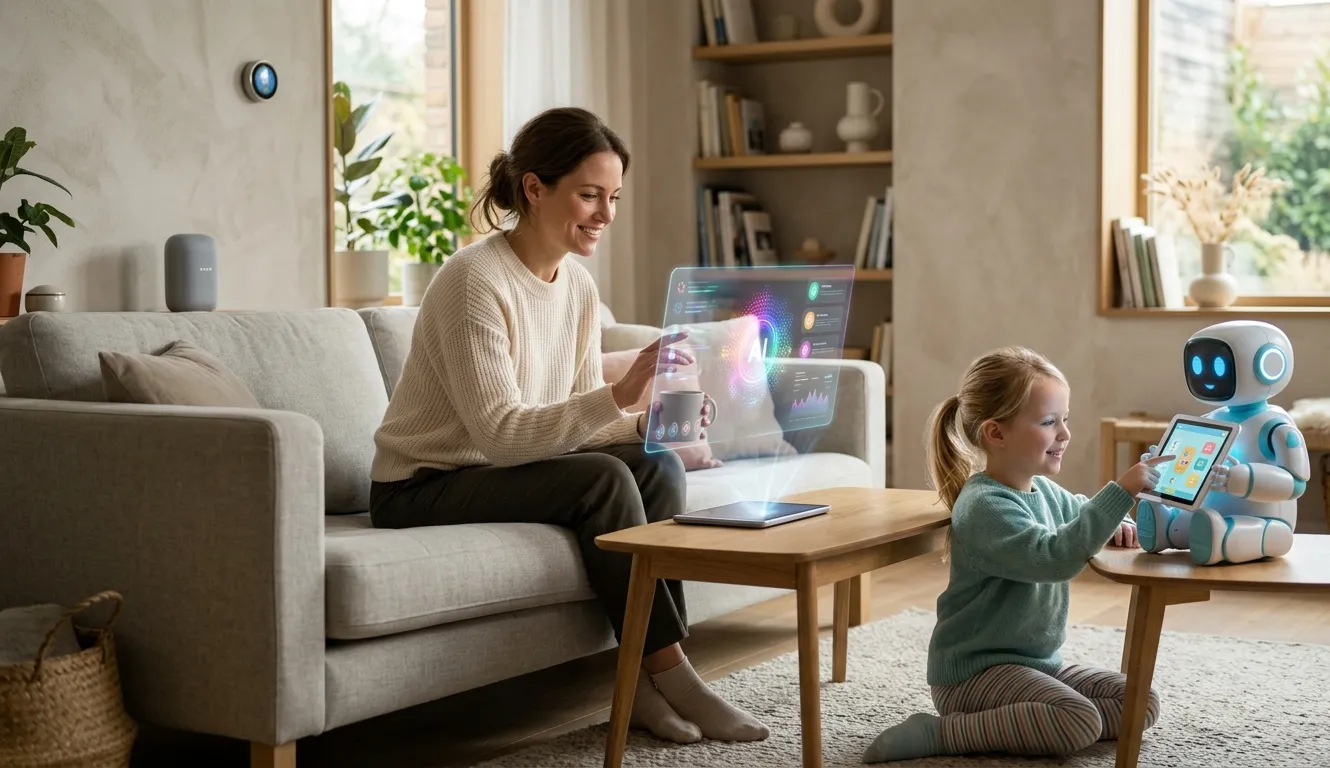

The 21st century has entered a decisive phase where Artificial Intelligence (AI) is not only transforming industries but redefining childhood itself. Today’s children are growing up in an ecosystem where AI is embedded in education, communication, and daily decision-making. This paradigm shift demands a fundamental transformation in parenting—from traditional supervision to strategic, research-informed guidance.
Recent global studies highlight the urgency of this shift. A 2026 multi-country survey revealed that 86% of students view AI as a helpful learning tool, while only 64% of parents share this confidence, indicating a critical perception gap that directly impacts guidance and decision-making at home. This gap underscores a key challenge: children are adapting faster than parents, while parental understanding remains limited.
Simultaneously, digital exposure has become deeply integrated into childhood. Research shows that 49% of parents rely on screens daily for managing children’s activities, often due to practical constraints. However, excessive or unguided screen usage has been linked with developmental concerns, including reduced vocabulary and attention challenges in early childhood. These findings clearly indicate that the issue is not technology itself, but the quality, purpose, and supervision of its use.
Modern parenting must therefore evolve into a model that integrates AI literacy, emotional intelligence, and critical thinking. Studies emphasize that parents’ own understanding of AI significantly enhances their confidence and effectiveness in guiding children’s learning journeys. In other words, empowered parents create empowered learners.
Equally important is the home environment. Contemporary research suggests that AI in early education should be guided by three pillars: trust, cultural values, and digital literacy, reinforcing the role of parents as primary architects of a child’s digital experience.
The future will not reward memorization—it will reward adaptability, creativity, and ethical decision-making. Therefore, parenting in the AI era must transition from control to coaching, from instruction to inspiration.
The challenge is profound, but so is the opportunity. Parents today are not merely raising children; they are shaping the architects of the future.
References
- Pew Research Center (2025) – Parenting & Screen Time Study
- OECD, Gallup & Multi-Country Surveys (2026) – AI in Education Trends
- Frontiers in Education Journal (2026) – Digital Tools & Early Childhood
- ScienceDirect (2025) – AI Literacy & Parenting Self-Efficacy
- World Journal of Advanced Research (2025) – AI in Early Childhood Framework
- Lurie Children’s Hospital Report (2025) – Screen Time Statistics
- The Guardian (2026) – Impact of Screen Time on Child Development