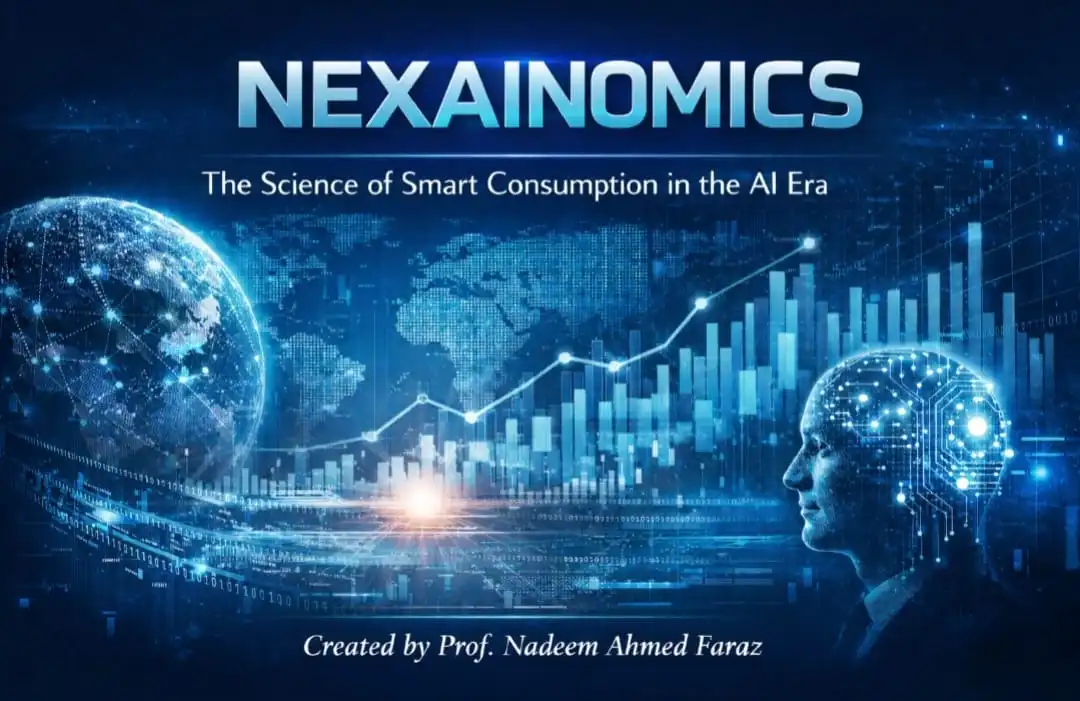

NEXAINOMICS: The Science of Smart Consumption in the AI Era
The global economy is entering a decisive transformation beyond 2030, driven by Artificial Intelligence, advanced data science, and predictive analytics. In this emerging landscape, Nexainomics—a newly conceptualized study created by Prof. Nadeem Ahmed Faraz—introduces a revolutionary framework for smart consumption and rational buying.
Nexainomics integrates behavioral economics, AI-powered forecasting, and collective purchasing intelligence to reshape digital commerce. It empowers consumers to make data-backed decisions through future buying, pool buying, and global alignment with like-minded buyers. Instead of reactive purchasing, consumers participate in predictive demand systems that influence production planning and market trends.
Simultaneously, manufacturers, industries, traders, and marketing agencies gain direct access to future demand clusters. This eliminates excessive intermediaries, reduces marketing and distribution costs, and enables customized production for specific consumer groups. Through direct digital negotiation and data transparency, both consumers and producers benefit: buyers secure optimal pricing, and manufacturers receive advance orders that enhance operational efficiency and strategic forecasting.
Nexainomics thus proposes a structural shift from traditional e-commerce to intelligent commerce—where purchasing decisions are not impulsive but analytical, collaborative, and future-oriented. It represents the evolution of economic behavior in the age of AI and anticipates a new global model of production-consumption alignment.
References
- United Nations Conference on Trade and Development – Digital Economy Reports
- World Economic Forum – Future of Consumption & AI Studies
- McKinsey & Company – AI in Retail & Predictive Analytics Reports
- Organisation for Economic Co-operation and Development – Consumer Policy & Digital Markets Research
- Harvard Business School – Research on Behavioral Economics & Data-Driven Strategies