
Abstract
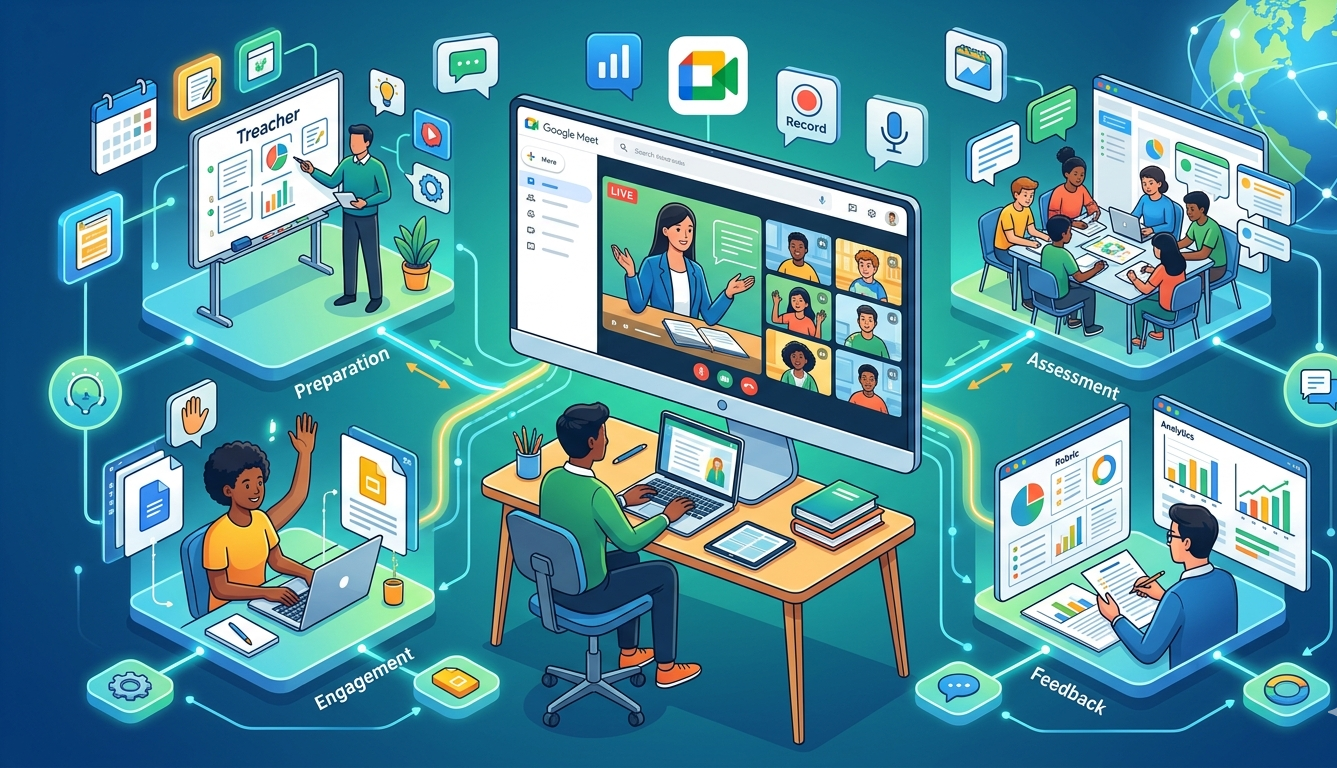
The global transition toward digital education has accelerated the adoption of synchronous learning platforms such as Google Meet. This study develops a structured framework for the effective utilization of Google Meet in school-level education. Drawing upon pedagogical theory and practical implementation, the paper identifies key success factors including teacher preparedness, student engagement, digital discipline, and instructional design. The findings suggest that well-defined operational guidelines significantly enhance learning outcomes, interaction quality, and academic performance in virtual classrooms.
Keywords
Digital Learning, Google Meet, Online Education, Virtual Classrooms, Teacher Training, Student Engagement, EdTech, Synchronous Learning, Academic Excellence
1. Introduction
The rapid evolution of Information and Communication Technologies (ICT) has transformed the educational landscape, shifting traditional classrooms toward digitally mediated environments. The COVID-19 pandemic further intensified reliance on virtual platforms, making synchronous tools indispensable for continuity in education (Hodges et al., 2020). Among these, Google Meet has emerged as a widely accessible and scalable solution for live instruction. However, the effectiveness of such platforms is contingent upon structured usage, pedagogical alignment, and user discipline.
2. Literature Review
Existing research highlights that effective online learning depends on interaction, engagement, and instructional clarity (Anderson, 2008). The Community of Inquiry (CoI) framework emphasizes cognitive, social, and teaching presence as critical elements of successful online education (Garrison, Anderson & Archer, 2000). Studies further indicate that synchronous tools improve immediacy and participation when supported by clear guidelines and trained facilitators (Martin & Parker, 2014). Conversely, lack of structure leads to disengagement and reduced learning efficiency.
3. Methodology
This research adopts a qualitative and observational approach based on practical implementation in school environments. Data was derived from structured classroom practices, teacher training sessions, and student behavioral analysis during live sessions. The study evaluates effectiveness across four dimensions: technical readiness, instructional delivery, engagement strategies, and behavioral discipline.
4. Findings and Analysis
4.1 Teacher Preparedness and Instructional Design
Teachers play a pivotal role in virtual learning success. Effective practices include pre-class planning, content segmentation, and utilization of interactive tools such as screen sharing and questioning techniques. Structured lesson delivery significantly enhances comprehension and retention.
4.2 Student Engagement and Digital Discipline
Student participation is directly linked to learning outcomes. Practices such as punctual joining, active listening, and adherence to communication protocols foster a productive learning environment. Digital discipline minimizes disruptions and enhances focus.
4.3 Technological Effectiveness
Google Meet provides a robust platform for synchronous communication; however, its effectiveness depends on user competency. Training in platform features—such as muting controls, chat utilization, and presentation tools—is essential for seamless interaction.
4.4 Structured Guidelines as a Performance Enabler
The implementation of standardized guidelines ensures consistency, accountability, and professional conduct. Institutions that adopt formal digital protocols report improved engagement and academic outcomes.
5. Discussion
The integration of digital platforms into education represents a paradigm shift rather than a temporary adaptation. To maximize benefits, institutions must invest in capacity building, digital literacy, and policy frameworks. The alignment of technology with pedagogy is critical to achieving sustainable educational transformation.
6. Conclusion
The study concludes that the effective use of Google Meet in education requires a holistic approach encompassing technical readiness, pedagogical strategy, and behavioral discipline. Teachers must adopt a leadership role in guiding digital learning, while students must demonstrate responsibility and engagement. This synergy creates a dynamic and future-ready educational ecosystem.
7. References
- Anderson, T. (2008). The Theory and Practice of Online Learning. Athabasca University Press.
- Garrison, D. R., Anderson, T., & Archer, W. (2000). Critical Inquiry in a Text-Based Environment. The Internet and Higher Education, 2(2-3), 87–105.
- Hodges, C., Moore, S., Lockee, B., Trust, T., & Bond, A. (2020). The Difference Between Emergency Remote Teaching and Online Learning. Educause Review.
- Martin, F., & Parker, M. A. (2014). Use of Synchronous Virtual Classrooms: Why, Who, and How? MERLOT Journal of Online Learning and Teaching, 10(2), 192–210.